Pages

Monday, October 14, 2019

Reference Services: The Realities and Challenges

LIBE 467 Theme 2: Blog Post

                          Collaboration by Nick Youngson CC BY-SA 3.0 Alpha Stock Images

What stayed with me from the first lesson of our learning on theme 2, was that being proactive could improve the success of the reference interview. One of the important ways to be proactive is through collaboration in planning and teaching of information literacy skills so that students can find maximum success. Even though Riedling does not stress it, collaborating with classroom teachers in the planning of research units and teaching research skills to students would be helpful. Haycock (2007) concludes that “Collaboration is not easy. But collaboration is the single professional behavior of teacher-librarians that most affects student achievement” (32). Last week a class arrived in the library to do “research” using the laptops and the internet. The teacher arrived approximately 15 minutes after the students. They had all begun work on their projects. As I circulated it became obvious that their teacher had made several assumptions about their level of skill. The students really were unsure about reliable websites and currency. I thought about the statement in our class notes, "Why many teachers don't consider the key role of the teacher-librarian when the assigning research/reference work to students is a question that has plagued us for years” (Beaudry, 2019, class notes). Later on in the class it became apparent that some of the students had no idea how to print. Had I been in the class even to explain the process for printing, this alone could have alleviated significant stress for the students and saved much time that would have allowed me to engage with students in reference interviews. Some of the students ended up feeling like they were unable to complete the task as assigned. Twenty minutes of time before the students started their research would have saved hours of individual explanations and would have resulted in greater student success. You never want the students’ first experience in the learning commons to be a frustrating one.
           Leinonen, S. (2017, December 3). 7 principles of teamwork for teacher  
                               collaboration (T.A.R.G.E.T.S.).  

In the second and third parts of the theme, the overwhelming amount of work to manage the reference collection became apparent. As I reflected on the Role of the Teacher-Librarian I realized that a plan to manage the budget and organization of the reference resources was very important. In the class notes lesson 6, there is a list of stages in collection development. When I looked at my role in the LLC, I realized that I was doing many of the stages for different sections of the library collection at the same time. For example, the grade 9 class does a unit on planets. Last year, along with the science teacher, we analyzed the books in the collection for the project. We weeded the ones that were no longer accurate and were in poor condition. In collaboration with the science teacher, I have purchased some new materials. This is just a small section of the collection and much needs to be done in other sections as well. The circular nature of the stages of collection development means that it is an ongoing process. I am looking forward to working with the social studies teachers and applying the collection management activities to parts of the reference section. 


Beaudry, R. (2019). LIBE 467: Lesson 5: The reference interview: Cooperative program planning and teaching for personalized inquiry. Class notes. Retrieved from: https://canvas.ubc.ca/courses/41996/pages/lesson-5-the-reference-interview-cooperative-program-  planning-and-teaching-for-personalized-inquiry?module_item_id=1308253

Haycock, K. (2007). Collaboration: Critical success factors for student learning. School Libraries Worldwide13(1), 25–35.

Leinonen, S. (2017, December 3). 7 principles of teamwork for teacher collaboration  (T.A.R.G.E.T.S.).  Retrieved October 11, 2019, from https://youtu.be/qx95qRuZA9Y.

Youngson, N. (n.d.). CollaborationAlpha Stock Images. Photograph. Retrieved from http://www.picpedia.org/highway-signs/c/collaboration.htm

Sunday, September 29, 2019

It's time to say goodbye...to a reference resource


LIBE 467: Assignment 1

Students need the best tools possible to find the answers to question they are asking. One of the most critical jobs of the Teacher-Librarian “is the selection and evaluation of reference materials” (Riedling, 2013, 18). Ongoing evaluation using specific criteria is necessary to maintain the reference resources that are current and useful. As well, collaborating with teachers with regard to their students’ needs helps to direct my selection of resources.

Part 1: Evaluation of a Reference Resource:  

In looking through our reference section we have a number of resources that should be removed due to copyright date alone—some were published more than ten years ago. I focused on the section on Canada—atlases, encyclopedias, almanacs, and the factbook that I chose to evaluate. I am considering whether to keep or deselect Facts about Canada, its Provinces and Territories by Jean Weihs. To begin I will look at the resource for relevancy, purpose, currency, curricular connections and efficient use of library space. Then I will consider whether to keep or discard it according to a rubric that follows.


Relevancy
Facts about Canada, its Provinces and Territories addresses a subject of relevance to many of the patrons in the library. Canada is the main subject in several courses in the social studies department. As well, we have a number of students new to Canada who are interested in learning more about the country they currently live in.
Purpose.
Facts about Canada, its Provinces and Territories does contain much useful information and many facts about Canadian provinces and two of its territories. Each province has a section on history with accurate dates regarding the establishment of trading posts and battles. It is organized in a way that makes it easy to find the information.

Currency:
As far as I can tell this book was only published one time, in 1995. None of my searches turned up any other edition. The book is currently for sale, the 1995 edition, on Abe books and on Amazon through third-party sellers, as new, for approximately $60. It made me wonder if selling discarded books could be a revenue stream for the Library Learning Commons. Our copy is pristine—no marks, bent pages, very few signs of wear.

Curricular Connections:
There are three courses in our Social Studies department that focus on Canada—Grade 9 Canada in the Contemporary World, Grade 10 Geographic Issues of the 21st Century, and Grade 11 History of Canada. Since Canada is the specific focus of three of our compulsory high school Social Studies courses it is important to have reference resources such as a factbook that support the outcomes of these courses. The purpose of factbooks is to provide “basic facts on particular topics such as countries, sports or time periods” (Riedling, 2013, 37).

Both the grade 9 and Grade 10 courses require that students are able to identify elements of physical geography (provinces, territories, cities etc.).
Grade 9 Canada in the Contemporary World
From the Manitoba Grade 9 (2007) social studies curriculum document:
Students will:  
9-KL-024 Identify on a map distinguishing elements of the physical and human geography of Canada. Include: political boundaries, capital cities, population clusters, regions.

Grade 10 (2006) Geographic Issues of the 21st Century
Learning Experience 1.2: Physical and Human Geography specifically:
KL-009 Identify elements of physical and human geography
KL-013 Locate provinces, territories, and capital cities on a map of Canada.

Grade 11 History of Canada
While the book purports to be: “A unique source of information about the provinces and territories of Canada, covering geography, climate, population, cities, government, politics, economy, history, culture, education and in many other topics” (Weihs, 1995, cover), it barely touches on Canada’s Indigenous population.

Its use is limited with regard to the following grade 11 curricular outcome:

From the Manitoba Curriculum document (2014) “Addresses essential question of “How has Canada’s history shaped the Canada of today?
      First Nations, Métis, and Inuit peoples play an ongoing role in shaping Canadian history and identity.”

Accuracy
Many of the facts listed are accurate: Date of Entry into Confederation, Capital City, and Motto. There are sections of the book that are wildly inaccurate. With a publication date of 1995 Nunavut is, understandably, not included at all in the book. The sections on Finances provide dollar amounts that are no longer accurate. Population statistics are wrong. Canada’s Indigenous populations are hardly mentioned. When they are, terminology used is no longer considered appropriate. For example, “Cree Indian” and “Iroquois Indian.” We have a significant population of international students and of new immigrants to Canada and I would not want them to base an understanding of Canada on this book.
 It seemed unusual to me that many government departments are listed by phone number. I called a few of them and surprisingly they still worked. There are no websites listed at all.
An interesting section of the book was the description of the provincial and territorial flags. There are no colour pictures in the book so they are all described. Here is the description of Manitoba’s flag: “A red field with a Union Jack in the upper left corner and the provincial shield on the centre right” (Weihs, 1995, 51). Since the author could not just look up the flags on the internet, and colour printing was not very common, it would have taken much more effort than it would today to find the flags and write an accurate descriptions.

Efficient use of library space
The book measures 7” by 10” and fits easily on the reference shelves. It is hard cover and large enough to be distinguished from smaller paperbacks. It would be easy to find and not so large that it is cumbersome to use.

Chart used for evaluation of the Facts about Canada its Provinces and Territories
Criteria
Below standard
Acceptable
Exemplary
Relevancy/curricular support
Materials support few curricular areas
Materials support 3 or more curricular areas
Materials can be used with five or more curricular areas.
Purpose
Most or all of the resource cannot be used for its intended purpose
Some of the resource cannot be used for its intended purpose
All of the resource can be used for its intended purpose
Currency
Copyright dates older than 10 years
Copyright dates within last 5 years
Copyright dates within the last 2 years
Accuracy
The resource is not accurate.
The resource is consistently accurate
The resource is accurate and provides  bibliographic support
Cost of the resource
N/A Resource no longer available
Cost is too high to warrant purchase of resource.
The cost of the resource is warranted based on value resource provides.
Resource provides excellent value according to cost.
(Adapted from: Asselin, 2003, pages 33-34)

Part 2: Search for an alternate work

I thought it would be fairly easy to replace this Facts About book published by H. W. Wilson. In Reference Skills for the School Librarian, Riedling (2013) mentions H. W. Wilson in the Factbooks section (41). The company is still publishing library reference materials and lists on its website other Facts About books. However, it does not list the resource I have evaluated, nor any other factbook specifically about Canada. In fact they ones they still have on the site are published long ago. For example the Facts About China book was published in 2000 and is listed for 120$. I imaged a replacement would be approximately the same cost.  

As a replacement resource I chose an online reference source: The Canadian Encyclopedia.

Relevancy/curricular support: The material is relevant and interesting to both students and teachers. It provides an easy to navigate website. 

Purpose: The Canadian Encyclopedia provides Canadians and others with accurate, updated information about the country and its people.

Currency: The Canadian Encyclopedia is current. It is maintained by Historica Canada.

Accuracy: The website is accurate. Articles contain bibliographic references to substantiate what is said.

Efficient use of space: The resource is found online so requires no library shelf space.

Cost of resource: the online Canadian Encyclopedia is free, making it an exceptional value. A link will be provided on the library web-page so that this resource can be accessed easily.

Chart used for evaluation of The Canadian Encyclopedia
Criteria:
Below Standard Acceptable
Exemplary
Relevancy/curricular support
Materials support few curricular areas
Materials support 3 or more curricular areas
Materials can be used with five or more curricular areas.
Purpose
Most or all of the resource cannot be used for its intended purpose
Some of the resource cannot be used for its intended purpose
All of the resource can be used for its intended purpose
Currency
Copyright dates older than 10 years
Copyright dates within last 5 years
Copyright dates within the last 2 years
Accuracy
The resource is not accurate.
The resource is consistently accurate
The resource is accurate and provides extensive bibliographic support
Cost of the resource

Cost is too high to warrant purchase of resource.
The cost of the resource is warranted based on value resource provides.
Resource provides excellent value according to cost.

References

Asselin, M., Branch, J., & Oberg, D., (Eds) (2003). Achieving information literacy: Standards for  
schoollibrary programs in Canada. Ottawa, ON: Canadian School Library Association & 
The  Association for Teacher-Librarianship in Canada. 

Manitoba Education and Advanced Learning (2014). Grade 11 History of Canada: A foundation for
 Implementation (Curriculum Guide). Retrieved from:

Manitoba Education, Citizenship. (2006). Geographic Issues of the 21st Century (Curriculum Guide).
                Retrieved from: 
                https://www.edu.gov.mb.ca/k12/cur/socstud/frame_found_sr2/cluster1.pdf 

Manitoba Education, Citizenship and Youth (2007).  Grade 9 social studies Canada in the
            contemporary world: A foundation for implementation. Retrieved from:

Riedling, A. (2013). Reference skills for the school library media specialist: Tools and tips, (Third 
         Edition).  Santa Barbara, CA: Linworth.  

The Canadian Encyclopedia: Historica Canada. (n.d.). Retrieved from

Weihs, J. (1995). Facts about Canada, its provinces and territories. United States of America: H. W.
 Wilson Company.

Monday, September 23, 2019

Inquiring minds want to know


LIBE 467 Information Services 1: Blog Post Theme 1

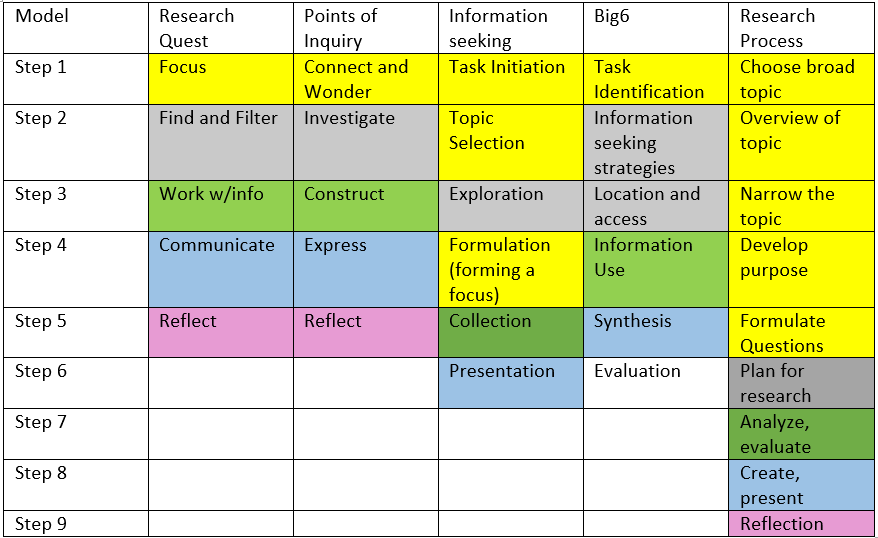
A teacher-librarian has an important role to fill in the school. They need to have excellent knowledge of the resources in the library, they need to be able to talk to students and staff, and finally they need to be able to choose the best resources to help students and staff meet curricular outcomes (Riedling, 2013, 4). In beginning this course, I recognize how important it is to start with a clear understanding of ‘reference sources and services.' The teacher-library is tasked with the job of “assisting students in finding the answers to questions and helping them become independent users of information and ideas” (Riedlling, 2013, 4). To do this we need an understanding of how best to help students use reference sources “materials, from book to computer to periodical to photograph that can be found anywhere in the library or online” (Riedling, 2013, 18). The Teacher-librarian also needs to understand and be able to employ a variety of inquiry models to guide students as they engage in research to answer questions and learn. It is a lot more complicated than it sounds, just take a look at this chart comparing 5 different inquiry models.
Chart: Comparison of Inquiry models (Riedling, 2013, p.10) (Beaudry, 2019, Course notes, lesson two) (BCTLA, https://bctladotca.files.wordpress.com/2018/02/the-points-of-inquiry.pdf (Links to an external site.))


The colours indicate areas of similarity.  Each model requires that students learn and master tasks so that they can effectively engage in inquiry. Questioning and writing questions is an area where students have to learn and practice so that they can explore deeply. 

Once they have a direction for inquiry students need guidance, and resources so that they can investigate and explore.  The necessity of selecting the best possible reference resources has become a priority. I was alarmed when comparing the current library reference materials with the standards listed in Achieving Information Literacy. I was especially concerned with the fact that many of the reference sources are long past their best before dates and do not meet the benchmark of “copyright dates within the last 10 years” (Asselin, 2003, 33). Fewer than 50% of the reference resources have copyright dates within the last 10 years and many are much older. Evaluating these resources will provide an opportunity to acquire more appropriate and useful materials for students and staff. These are not the type of accurate resources needed by the student body. Two areas in the reference section that met the criteria: the new dictionaries and the new Indigenous atlas set.


What I need to work toward is the trifecta of the Library Learning Commons—becoming a more skilled teacher-librarian, acquiring the best reference resources, and assisting students to inquire and learn.

Asselin, M., Branch, J., & Oberg, D., (Eds) (2003). Achieving information literacy: Standards for school library programs in Canada. Ottawa, ON: Canadian School Library Association & The
Association for Teacher-Librarianship in Canada.

BCTLA. (2011). The points of inquiry: A framework for information literacy and the 21st century learner. https://bctladotca.files.wordpress.com/2018/02/the-points-of-inquiry.pdf (Links to an external site.)

Beaudry, R. (2019). Lesson 2: The Reference Process and Information Skills, Course notes. Retrieved from https://canvas.ubc.ca/courses/41996/pages/lesson-2-the-reference-process-and-information-skills?module_item_id=1308244


Riedling, A. (2013). Reference skills for the school library media specialist: Tools and tips, (Third Edition). Santa Barbara, CA: Linworth. 


Friday, August 9, 2019

LLED 441 Assignment 3: Reflective Bibliography

Initially I thought I would organize my reflective bibliography as a journey through the modules. I would highlight one or two books that I found had insights or connections to the topic and comment on them. This ended up being too linear and I found it difficult to organize—sometimes a book seemed to fit into more than one topic. Sometimes a book did not fit into any category well but I wanted to include it anyway and found myself trying to get it to belong when it did not. After looking at the list I decided to organize this bibliography according to questions. The overriding question is from the Module 10 video by Linda Sue Park, “Can a children’s book change the world?” More specifically the questions that organize my bibliography are: 

Can a children’s book change the way people see themselves and each other?

One of the ideas that connected many of my choices was diversity. Many students do not see themselves in the canonical literature they are assigned to read. In her speech, “Books that are windows. Books that are doors” Patsy Aldana (2008) asks that we consider, “what is the long term effect on a child of a steady diet of books from which he is totally absent or present but falsely depicted?” How can students feel that they are valued in society if they are not represented? Rudine Sims Bishop’s (1990) metaphor, that books are sometimes windows, through which we see others, sometimes mirrors, reflecting ourselves, and sometimes doors, through which we can enter other realities, resonated with me.

I realized that many of the books on my list could be categorized into mirrors, doors and windows. Some books belonged in more than one category. I believe books that are diverse, help address the social justice issue of equity. Why should one culture be the only one represented? Culturally responsive texts are necessary. The books I’ve included in this category tell diverse stories. The Day War Came tells of one girl’s escape from war to a country where she faces challenges going to school. The children’s book, And Tango Makes Three provides a window into a family with two dads. The graphic novel, American Born Chinese illustrates the challenges of fitting in for a Chinese student who is the only Chinese person in the school. The YA science fiction novel Binti (the first in a trilogy) won both the 2015 Hugo and Nebula awards. It follows a Binti, a young woman, first of her people to be offered a place at the finest university in the galaxy. It is a time of war and Binti is the only one who is capable of ending it.


I included two additional resources with an indigenous focus, This Place: 150 Years Retold, and Jeremy Dutcher singing with the elders of his nation in the endangered Wolastoq language. This Place opens with a forward by Alicia Elliot that takes issue with the idea that only the history of victors is the history that should be written. These stories put Indigenous people and their stories of the past 150 years “front and centre on our own lands” (Elliot, 2019, v). The music of Jeremy Dutcher allows us to hear the recorded voices of elders speaking in a language that few currently speak.


The final book in this category is the YA book Belzhar, by Meg Wolitzer. It tells the story of 5 teens who end up a therapeutic boarding school after each suffers a traumatic event. This book shines—it reveals all the ways people fool themselves. Then it is masterful in showing what it takes for the characters to each face the truths of their lives. The ideas in these books and videos will influence the choices I make and possibly the collaborations I will work on during the school year.


Can a children’s book change the way we treat the planet?

In Module 7: Considerations: Fiction, Novels and the Young Adult Genre, I was influenced by the article by Beach on climate fiction. The article, “Literature and the Cli-Fi Imagination” starts off with an important question, “What will happen to the Earth and to human beings in a future shaped by global warming?” (Beach, 2017, 51).  I had never heard about climate fiction as a sub-genre of science fiction before. This article prompted me to reassess how I viewed other YA post-apocalyptic novel through a climate lens. Many YA texts are set in a post-apocalyptic world that suffers from a climate affected by a catastrophic event such as nuclear war. These books are scary but lack immediacy. The YA novel Dry, set in the California of the very near future, is scary for right now. In Manitoba and in many other provinces we are suffering some of the hottest summers on record. The idea that water could run out is something I think about every morning when I water the garden. I also included Shipbreaker on my list in this category. The descriptions of the storms that occur how the changed climate wreaks havoc on the people are frightening.  The book The Elders are Watching brings an Indigenous perspective to protection of the planet. People make mistakes and harm the planet. The Elders are angry, and it is time to hear their calls and save the land. Finally, in this section, I included the wordless picture book Belonging by Baker. In the authors’ note, Baker explains that people often think that land belongs to them. However, the book shows that “it is the other way around: we belong to the land. If we keep it healthy, it will sustain the web of life on which we depend” (Baker, 2004, Authors’ note). The urgency with which our planet needs help and the necessity of having students act in this regard is why addressing this question and getting people to take action to save the planet is so important. One way is to read about the problem. “Research on the impact of environmental literature suggests that cli-fi also can make a difference...The results indicated that reading one or more of these texts did predict increased awareness and propensity to take action” (Beach, 2017, 53).


So then, can a children’s book change the world? According to Bishop, books can “help us to understand each other better by helping to change our attitudes towards difference. When there are enough bools available that can act as both mirrors an windows for all our children, they will see that we can celebrate both our differences and our similarities, because together they are what make us all human” (Bishop, 2019, paragraph 11).

After all this reading and learning, what is the focus for my professional development?  

In order to get students to read and to engage deeply with literature, I think it’s important to understand the ways constant access to information and entertainment have changed the brains of kids today. In the book, Reader Come Home, Maryanne Wolf (2018) examines how and why reading patterns are changing. She explores the struggles resulting because our students have constant access to feel good entertainment. This has sapped them of their desire to expend energy and time reading (75). 
A second professional development book on my list is 180 Days by Gallagher and Kittle. I agree with so many of the things they say in the book and with so many of the strategies they propose. “Unfortunately, too many adolescent readers suffer from an unhealthy school reading diet in which they fake or skim-read one whole-class novel, then another, then another. This agonizingly slow crawl through texts is continued month after month, year after year. Many give up believing that reading will not offer them anything except meaningless work” (Gallagher, 2018, 13).
A final professional development resource on my list is one recommended in the Course Resources: Maria Popova’s blob, BrainPickings. It is so rich in ideas, and books, and ideas about books that I am in awe. 

Bibliography

Aldana, P. (2008). Books that are windows, Books that are mirrors: How we can make sure that children see themselves in their books [Speech transcript]. Retrieved from http://www.ibby.org/index.php?id=1008

Bacigalupi, P. (2010). Shipbreaker. New York, N. Y.: Little, Brown and Company.

Baker, J. (2004). Belonging. London: Walker Books Ltd.

Beach, R. et al. (2017). “Literature and the Cli-Fi imagination” in Teaching Climate Change to Adolescents (pp. 51-66). New York, NY: Routledge. DOI https://doi-org.ezproxy.library.ubc.ca/10.4324/9781315276304

Bishop, R. (1990) The Ohio State University. "Mirrors, Windows and Sliding Glass Doors" originally appeared in Perspectives: Choosing and Using Books for the Classroom (6)3.

Bouchard, D. and Vickers, R. H. (Illustrator). (2003). The elders are watching. Richmond, British Columbia: Raincoast Books.

Davis, N. & Cobb, R. (Illustrator) (2018).  The Day War Came. Somerville, Massachusetts: Candlewick Press.  

Dutcher, J. (March 4, 2018). Lintuwakon ‘ciw mehchinut. CBC Music. https://youtu.be/NnDJNoNVqGw

Elliot, A. (Editor). (2019). This place: 150 years retold. Winnipeg, Manitoba: HighWater Press.

Gallagher, K. and Kittle, P. (2018). 180 days: Two teachers and the quest to engage and empower adolescents. Portsmouth, NH: Heinemann.

Okorafor, N (2015).  Binti. New York, N. Y.: A Tom Doherty Associates Book.
Popova, M. BrainPickings (Blog). https://www.brainpickings.org/

Richardson, J. and Parnell, P. and Cole, H. (Illustrator). (2005). And Tango makes three. Toronto, Ontario: Simon & Shuster Books for Young Readers.

Shusterman, N. and Shusterman, J. (2018). Dry. New York: Simon & Shuster Children’s Publishing Division.

Wolf, M. (2018). Reader come home. New York, N. Y.: HarperCollins Publishers.

Wolitzer, M. (2014). Belzhar. New York, N. Y.: Dutton Books for Young Readers.

Yang, L. G. (2006). American born Chinese. New York, N. Y.: Square Fish, an imprint of MacMillan.


Sunday, July 28, 2019

LLED 441 Assignment 2: Curation of Children's Literature


Option C: Investigate a particular subject

I thought it would be helpful and useful to curate a bibliography of books to use that would enhance the understanding of mental health issues. Mental health as a topic has become more common in children’s literature including books for the very young. Children are faced with many issues that can put their mental health at risk: stress, heartbreak, bereavement, trauma, depression, and anxiety. “In this day and age the impact of a student’s mental health on his/her ability to learn and achieve academically is becoming more and more widely understood, accepted, and addressed. In order for students to achieve at their greatest potential they must be educated in a safe and emotionally healthy environment”(Richmond, 2014, 19).  There are many books that can provide information, understanding and a sense of comfort to those with mental health issues. As discussing the topic of mental health becomes more acceptable, students can better understand themselves and their peers who might be suffering.

I teach in a high school and most of the titles I would usually choose are YA novels. However, the timeline for the course necessitated including shorter works and picture books. Reading these made me realize that picture books often contain powerful stories that are immediately useful and accessible. 

Books intended for the very young but are also useful for those who are older
1.     Berube, K. Mae’s First Day of School.
2.     James, M. The Funeral.
3.     Pinfold, L. Black Dog.
4.     Yum, H. (2018). Saturday is Swimming Day
These picture books explore the themes of anxiety (Mae’s First Day of School and Saturday is Swimming Day), depression (Black Dog), and death in the family (The Funeral).


The two books that deal with anxiety work through common situations for children—swimming lessons, and the first day of school—in effective ways. Mae’s First Day of School has the teacher join Mae and deciding that she is not going to school either because she is worried that the students won’t like her. The situations are resolved and the children move on. In Saturday is Swimming Lessons it takes longer than one day to work through the anxiety the child feels about the lessons, but after a few weeks, the lessons are no longer dreaded. The fear was mostly the fear of the unknown.

   
Graphic novels for middle years and YA students
1.     Britt, F. & Arsenault, I. (Illustrator). (2017). Louis Undercover
2.     Craft, J. (2019). New Kid.
3.     Elliot, R. (2017). It’s all Absolutely Fine.
4.     LaPointe, S. & Roge. (2017). Grandfather and the Moon (S. Tanaka Trans.).


All of these books deal with difficult mental health issues and have examples of young people taking action to improve the situations they are in. In Louis Undercover, Louis is in a stressful situation with divorced parents, an alcoholic father, and a girl he is in love who he is afraid to approach. At the end of the book Louis takes action to improve his happiness by talking to Billie. New Kid sees Jordan as the new kid at school with all of the requisite anxiety this brings. He is an artist so the book has several inserts he has drawn providing his perspective on the situations he has to handle: Jordan’s Tips for Taking the Bus; Judging Kids by the Cover of Their Books, The Dude Pyramid: A Guide to Cafeteria Hierarchy.  Ruby Elliot draws her way through the daily difficulties she faces in the book It's All Absolutely Fine. In Grandfather and the Moon, a young girl helps her grandfather deal with depression after the death of his wife.

YA Books that explore mental health themes
1.     Chbosky, S. (1999). The perks of being a wallflower.
2.     Jensen, K. (Ed) (2018). (Don’t) call me crazy: 33 voices start the conversation about mental health
3.     Priemaza, A. (2017). Kat and Meg conquer the world.
4.     Tomkins, M., & Martinez, K (2010). My Anxious Mind: A teen’s guide to managing anxiety and panic.
                                                        

When I told my daughter my topic, she suggested I read The Perks of Being a Wallflower (she also named my blog). I could see why she is a fan of the book. Charlie suffers from PTSD, anxiety and depression. He turns to drugs and alcohol. When the root cause of his problems is revealed he gets help. This book is signed out often from the school library.
(Don’t) Call Me Crazy is an anthology that exposes a number of mental health issues that students will find informative. The chapters are short and the stories are interesting. In Kat and Meg Conquer the World one of the main characters has ADHD and the other suffers from sever anxiety. When they have to work together on a science project they become friends and they help each other deal with their mental health issues. I included My Anxious Mind: A teen’s guide to managing anxiety and panic on my list because it provides some specific strategies for dealing with mental health issues.


Books that provide positive examples of mental health
1.     Beaumont, K., Catrow, D. (Illustrator). (2004). I Like Myself.
2.     DiOrio, R., Wheeler E. (Illustrator). (2010). What Does it Mean to be Present?
I wanted to include books that illustrate ways of being mentally healthy. I Like Myself is an ode to self-esteem. I love the dedication, “Wishing every child the magic of self-acceptance and love.” What Does it Mean to be Present shows children how to be mindful so that they can be present in their lives. “When we are all present, life can be much richer, fuller and happier!”


Video texts
1.     Green, John (July 25, 2017). What OCD is Like (for me). (YouTube video). Retrieved from:  https://youtu.be/jNEUz9v5RYo
John Green candidly discusses what OCD is like for him. Since he is one of the most popular YA novelists, and so many young people read his books, having him explain this mental health issue is very impactful.

The books and the video provide information on mental health issues that are prevalent with high school students. Using the books as resources can help build understanding among the teachers of the issues that the students struggle with. As well, the texts can help students understand mental health issues they and their friends are dealing with. On a final note, there are a number of other texts that I did not have time to read but would like to in order to include them on this list.: Turtles All the Way Down by John Green; Tiffany Sly Lives Here Now by Dana L. Davis; Every Last Word by Tamara Ireland Stone.  

Bibliography

Beaumont, K., Catrow, D. (Illustrator). (2004). I like myself. New York, NY: Houghton Mifflin Harcourt Publishing Company.

Berube, K. (2018). Mae’s first day of school. New York, NY: ABRAMS The Art of Books.

Britt, F. & Arsenault, I. (Illustrator). (2017). Louis undercover (C. Morelli and S. Ouriou Trans.). Toronto: Groundwood Books, house of Anansi Press. (Original work published 2016).

Craft, J. (2019). New Kid. New York, NY: HarperCollins Children’s Books.

Chbosky, S. (1999). The perks of being a wallflower. New York, NY: Gallery Books.

DiOrio, R., Wheeler E. (Illustrator). (2010). What does it mean to be present? USA: little Pickle Press, Inc.

Elliot, R. (2017). It’s all absolutely fine. Kansas City, Missouri: Andrews McMeel Publishing.

Green, John (July 25, 2017). What OCD is like (for me). (YouTube video). Retrieved from:  https://youtu.be/jNEUz9v5RYo

James, M. (2018). The funeral. Toronto: Groundwood Books, house of Anansi Press.

Jensen, K. (Ed) (2018). (Don’t) call me crazy: 33 voices start the conversation about mental health. Chapel Hill, North Carolina: Algonquin Young Readers.

LaPointe, S. & Roge. (2017). Grandfather and the moon (S. Tanaka Trans.). Toronto: Groundwood Books, House of Anansi Press. (Original work published 2017).

Pinfold, L. (2011). Black Dog. Somerville, Massachusetts: Templar Books an imprint of Candlewick Press.

Priemaza, A. (2017). Kat and Meg conquer the world. New York, NY: HarperCollins Children’s Books.

Richmond, K.J. (2014). Using literature to confront the stigma of mental illness, teach empathy and break stereotypes. Language Arts Journal of Michigan (30)1 DOI: https://doi.org/10.9707/2168-149X.2038

Tomkins, M., & Martinez, K (2010). My anxious mind: A teen’s guide to managing anxiety and panic. Washington, DC: Magination Press.

Yum, H. (2018). Saturday is swimming day. Somerville, Massachusetts: Candlewick Press.